A Japan honeymoon gives you two trips in one: the energy of Tokyo and Osaka, and the calm of hot spring inns, temple gardens and slow multi-course dinners served in your room. Trains are fast and punctual, and the food alone could fill two weeks.
This guide suggests a 10 to 12 day itinerary for first-timers, explains when to go (and when to be careful), lists the nonstop flights from the US, looks at whether the Japan Rail Pass still makes sense, and covers ryokan and onsen etiquette along with the entry rules for US citizens.
Why Japan Works for Newlyweds
Japan suits couples who want variety without complicated logistics. In one trip you can stay above Tokyo, soak in a hot spring inn, walk Kyoto’s lantern-lit lanes and eat your way through Osaka. The main cities sit along one high-speed rail line, so moving between them takes hours, not days.
Popular ryokan and seasonal dates book up early, so plan ahead. If you are still comparing options, our overview of honeymoon destinations around the world puts Japan alongside beach and European choices by season.
A 10 to 12 Day Japan Honeymoon Itinerary
This route follows the classic “Golden Route” from Tokyo to Kyoto and Osaka, with a ryokan night in the mountains between them.
| Days | Base | Highlights |
|---|---|---|
| 1 to 3 | Tokyo | Neighborhoods, food halls, gardens, city views at night |
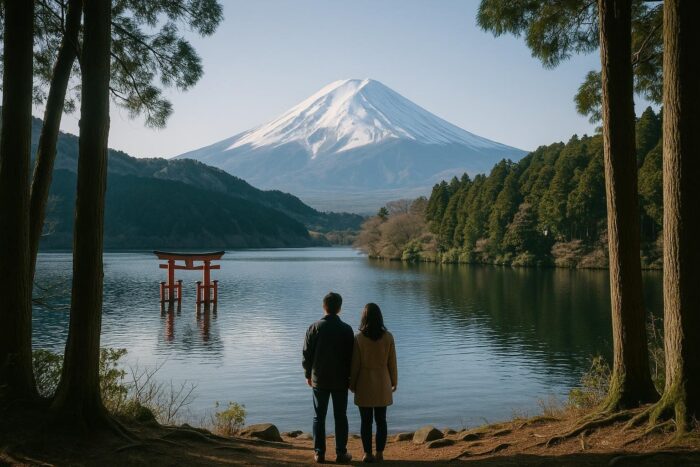
| 4 to 5 | Hakone | Ryokan stay, onsen, Lake Ashi, views of Mount Fuji on clear days |
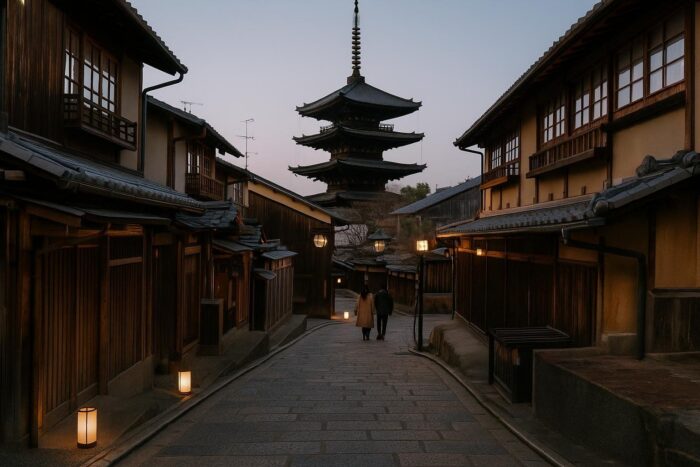
| 6 to 8 | Kyoto | Temples, shrines, historic lanes, kaiseki dinner |
| 9 to 10 | Osaka and Nara | Street food, nightlife, a day trip to Nara’s temples and deer park |
| 11 to 12 (optional) | Okinawa or Kanazawa | Beaches, or gardens and old teahouse districts |
Tokyo (days 1 to 3)
Keep the first day easy to adjust to the time difference, then plan each day around one or two neighborhoods rather than crossing the city repeatedly.
Hakone (days 4 and 5)
Hakone is part of Fuji-Hakone-Izu National Park and one of the easiest ryokan escapes from Tokyo. The Odakyu Romancecar runs from Shinjuku to Hakone-Yumoto in about 80 to 85 minutes, or you can take the shinkansen to Odawara. Lake Ashi and the volcanic valley of Owakudani fill a day; the evening belongs to the bath.
Kyoto (days 6 to 8)
From Odawara, continue west by shinkansen; the fastest Nozomi trains link Tokyo and Kyoto in a little over two hours. Give Kyoto three nights, visit the famous temples early and save quieter gardens for the afternoon.
Osaka and Nara (days 9 and 10)
Osaka is Kyoto’s livelier neighbor, known for casual food and neon-lit evenings. Nara, home to Todaiji Temple and its giant bronze Buddha, is under an hour by Kintetsu train from either Kyoto or Osaka, which makes it an easy day trip.
Optional extension (days 11 and 12)
For a beach finish, fly to Okinawa: the flight from Tokyo Haneda takes roughly two and a half hours, and swimming is best from May through October. For more culture, Kanazawa is about two and a half hours from Tokyo on the Hokuriku Shinkansen, with Kenrokuen Garden and the Higashi Chaya teahouse district. Couples looking for something off the usual path can also compare our picks of less expected honeymoon spots.
Best Time for a Japan Honeymoon
Spring and cherry blossoms
Cherry blossoms open on average around March 24 in Tokyo and March 26 in Kyoto, with full bloom about a week later. Peak viewing lasts only about a week and can shift by a week either way, so book flexible hotels. Late April to early May is Golden Week, a busy domestic holiday period best avoided.
Autumn leaves
November is one of the most pleasant months: dry, mild and colorful. Kyoto usually peaks in mid to late November, and trees in Kyoto and Tokyo often stay colorful into early December. Hakone tends to change color earlier, from late October.
Rainy season and typhoons
The rainy season (tsuyu) usually runs from early June to mid-July on the main island of Honshu, and from early May to mid-June in Okinawa. Typhoon season peaks in August and September, with Okinawa and the southern coasts most exposed. Summer is hot and humid, and the Obon week in mid-August is crowded. Keep a buffer day before your flight home.
Flights From the US to Tokyo and Osaka
Tokyo has two international airports. Haneda is close to the city center and receives nonstop flights from a long list of US hubs, including Los Angeles, San Francisco, Seattle, Chicago, New York, Washington, Houston, Atlanta, Detroit, Minneapolis and Honolulu. Narita is farther out, about an hour from central Tokyo on the Narita Express or 40 minutes on the Keisei Skyliner.
For an open-jaw trip (into Tokyo, out of Osaka), Osaka’s Kansai International Airport has nonstop service from San Francisco on United, from Los Angeles on Japan Airlines and from Honolulu. Flying into one city and out of the other saves a day of backtracking. Schedules change by season, so confirm the route with the airline first.
Is the Japan Rail Pass Worth It?
The nationwide Japan Rail Pass became much more expensive in October 2023, and prices rise again on October 1, 2026 for passes bought through overseas agents. In 2026, the 7-day ordinary pass costs 50,000 yen on the official Japan Rail Pass website, which is keeping its current prices for now, versus 53,000 yen through agents from October. The pass also does not cover the fastest Nozomi trains without a supplement.
For the Golden Route above, individual shinkansen tickets usually cost less than the pass. It only pays off if you add long journeys, for example a round trip to northern Japan or to Kanazawa and back within the same week. Price your own route before you buy.
Ryokan and Onsen Etiquette
Staying in a ryokan
A ryokan night usually includes a multi-course kaiseki dinner and a Japanese breakfast. Take off your shoes at the entrance and use the slippers provided, but walk on tatami in socks or bare feet only. You will find a yukata (cotton robe) in your room; wrap it left side over right, and feel free to wear it to dinner and the baths.
Onsen basics
Wash and rinse thoroughly at the shower stations before entering the bath. Bathing is done without a swimsuit, and shared baths are generally separated by gender. Keep your small towel out of the water (many people fold it on their head), tie up long hair and skip alcohol before bathing.
Tattoos and private baths
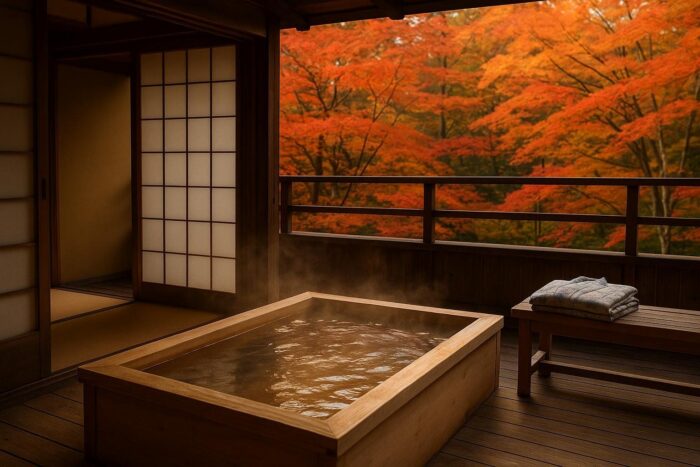
Some onsen still refuse guests with tattoos, although more facilities now call themselves tattoo-friendly. The simplest solution is a private bath, known as kashikiri buro, that you reserve for the two of you. Many ryokan also offer rooms with their own open-air bath. For a honeymoon, it is worth prioritizing anyway, since it lets you bathe together.
Entry Rules for US Citizens
US citizens can visit Japan without a visa for up to 90 days for tourism. Your passport must be valid for the length of your stay, and you should carry proof of onward travel. Before landing, you can register on Visit Japan Web, the official Digital Agency service, to get a QR code for immigration and customs; paper forms remain available.
Japan has passed a law creating JESTA, an online pre-travel authorization for visa-exempt visitors similar to the US ESTA. It is not live in 2026: the target launch is fiscal year 2028, and no later than March 2029.
Japan Honeymoon FAQ
How many days do we need for a Japan honeymoon?
Ten to twelve days covers Tokyo, a ryokan night in Hakone, Kyoto, Osaka and Nara at a relaxed pace, with room for one extension such as Okinawa or Kanazawa.
When is the best time to go?
Late March to early April for cherry blossoms, and November for autumn colors. Avoid Golden Week, and plan around the June rains and the August to September typhoon peak.
Can we bathe together in an onsen?
Shared public baths are usually separated by gender, so book a private kashikiri bath or a ryokan room with its own open-air bath.
Do US citizens need a visa or authorization for Japan?
No visa is needed for tourist stays of up to 90 days, and the planned JESTA authorization is not required in 2026.